1994

Kitty Kino, Der Gipfel von allem (1994), variety theater, at Jugendmusikfest Deutschlandsberg, Laßnitzhaus, Deutschlandsberg, 1994, photo: stefanharing.com

100 Umkleidekabinen: Ein ambulantes Kunstprojekt, exhibition view, Bad zur Sonne, Graz, 1994, photo: steirischer herbst archive / Philipp; © Bildrecht, Wien 2021

Pope, Save, performance, at Club DADADA: Die Avantgarde der Vernetzung, Bad zur Sonne, Graz, 1994, photo: steirischer herbst archive / Philipp

Franz West and Heimo Zobernig, Pokal auf Sockel (1994), sculpture, at Spielverderber, Forum Stadtpark, Graz, 1994, photo: Heimo Zobernig; courtesy of the artist; © Bildrecht, Wien 2021

Tomaž Pandur, Russische Mission (1994), play, with Cvetozar Cvetković, Schauspielhaus Graz, 1994, photo: Angelo Božac; courtesy of the artist
steirischer herbst ’94
Experience and Innocence
Director
Horst Gerhard Haberl
Festival dates
30.9.–23.10.1994
Curatorial team
Advisory Board: Werner Krause (theatre, literature), Cathrin Pichler (visual art), Peter Strasser (science)

“F.M. Dostoyevsky, Hugo Ball, Vilém Flusser and the observation of new dadaistic trends in art are the focus and at the same time in the background of the programme for this year’s steirischer herbst: within the framework of the series of themes which began in 1990 entitled ‘Nomadology of the Nineties’, we are attempting to trace the nomadic strategy of art after the end of avant-gardism within the polarization of the opposing terms EXPERIENCE AND INNOCENCE. However, this nomadism deals only secondarily with the worldwide movements of seeking refuge; on the contrary, what this means for us is the demand for intellectual mobility, for true interdisciplinarism, for a ‘notarizing sensibility’ (Peter Strasser), which, on the one hand, addresses those dimensions of art relevant to business; on the other hand, which is directed against the either-or-fixation of seemingly disparate disciplines in art, science, technology.”
—Horst Gerhard Haberl (original booklet translation)
In his foreword to the program booklet for 1994, Horst Gerhard Haberl compared steirischer herbst, which, this year, negated the guiding theme of Erfahrung und Unschuld (Experience and Innocence) with Magritte’s pipe: “A festival that already negates its existence in its subtitle. Perhaps a Dadaist approach. But more of a survival strategy.” Haberl argued that there was little room for a “low-budget enterprise” to maneuver “on the periphery of festivalized mega-events.”
The poster, which Haberl designed himself, shows a triangle with raised hands, a warning against “threats resulting from weapons.” The question of a new, dialogic, and political modernity that reacts to the ecological and economic “risk(-related) problems” of the 1990s was what steirischer herbst ’94 wanted to pose in its symposia (including one on Vilém Flusser, who died in 1991), exhibition projects, literature and film workshops, and particularly in its commissioned works. They included premieres of Beat Furrer’s musical theater piece Narcissus and Tomaž Pandur’s theater project Russische Mission (Russian Mission), which “spanned an arc between the lived irrationalisms of a Dostoyevsky and a Hugo Ball” and opened the festival at the Schauspielhaus (program booklet).
The exhibitions Spielverderber (Spoilsport; concept: Elisabeth Fiedler), with works by Cosima von Bonin, Mike Kelley, Martin Kippenberger, Jutta Koether, Chéri Samba, Jörg Schlick, Peter Weibel, and others, and Das Archiv (The Archive; concept: Christine Frisinghelli), held in conjunction with the Symposium on Photography XV, were shown at the Forum Stadtpark. The ambulatory art project 100 Umkleidekabinen (100 Changing Cubicles; curators: Paolo Bianchi and Martin Janda) took place at the landmarked, decommissioned open-air swimming pool Bad zur Sonne.
Program
Theatre / Music theatre / Event
Film Festival
Projects
Club Dadada
Exhibitions
Symposia
Out of Graz
Mürz Werkstatt Konzert 7.10.1994
Mürz Werkstatt Konzert 11.10.1994
Mürz Werkstatt Konzert 13.10.1994
Mürz Werkstatt Konzert 14.10.1994
Hör-Fest Stainach Konzert 2.10.1994 I
Hör-Fest Stainach Konzert 2.10.1994 II
Hör-Fest Stainach Konzert 21.10.1994
Hör-Fest Stainach Konzert 22.10.1994
Hör-Fest Stainach Konzert 23.10.1994
Silent Film-Loud Music Project
Under Cover Collection Band 10.10.1994
Festival opening
30.09., 17:30
Schauspielhaus
Opening
19:00
RUSSISCHE MISSION (UA), A theatre project by Tomaž Pandur
Venues
Alter Pfarrhof, Pischelsdorf
Bad zur Sonne
CCW, Cultur Centrum Wolkenstein, Stainach
Forum Stadtpark
Franziskanerkirche, Graz
Hauptplatz, Deutschlandsberg
Kammermusiksaal (Grazer Kongress)
Kulturhaus Graz
Kulturzentrum bei den Minoriten
Kunsthaus Mürzzuschlag
Künstlerhaus
Laßnitzhaus, Deutschlandsberg
Maiahilferkirche
Mehrzweckhalle, Mürzsteg
Mehrzweckhalle, Spital am Semmering
Musikschule Deutschlandsberg
ORF-Landesstudio
Oper Graz
Opernhaus, Spiegelfoyer
Orpheum
Palais Attems
Palais Meran
Rosenhain, mittlerer Teich
Römisch-katholische Pfarrkirche, Krieglach
Saal Steiermark (Grazer Congress)
Schauspielhaus Graz
Schubertkino
Stefaniensaal (Grazer Kongress)
Städtisches Volksbad, Augarten
TaO! Theater am Ortweinplatz
Teppichgalerie Reinisch
Wall Zentrum
Werkstadt Graz
stadtmuseumgraz
Publications
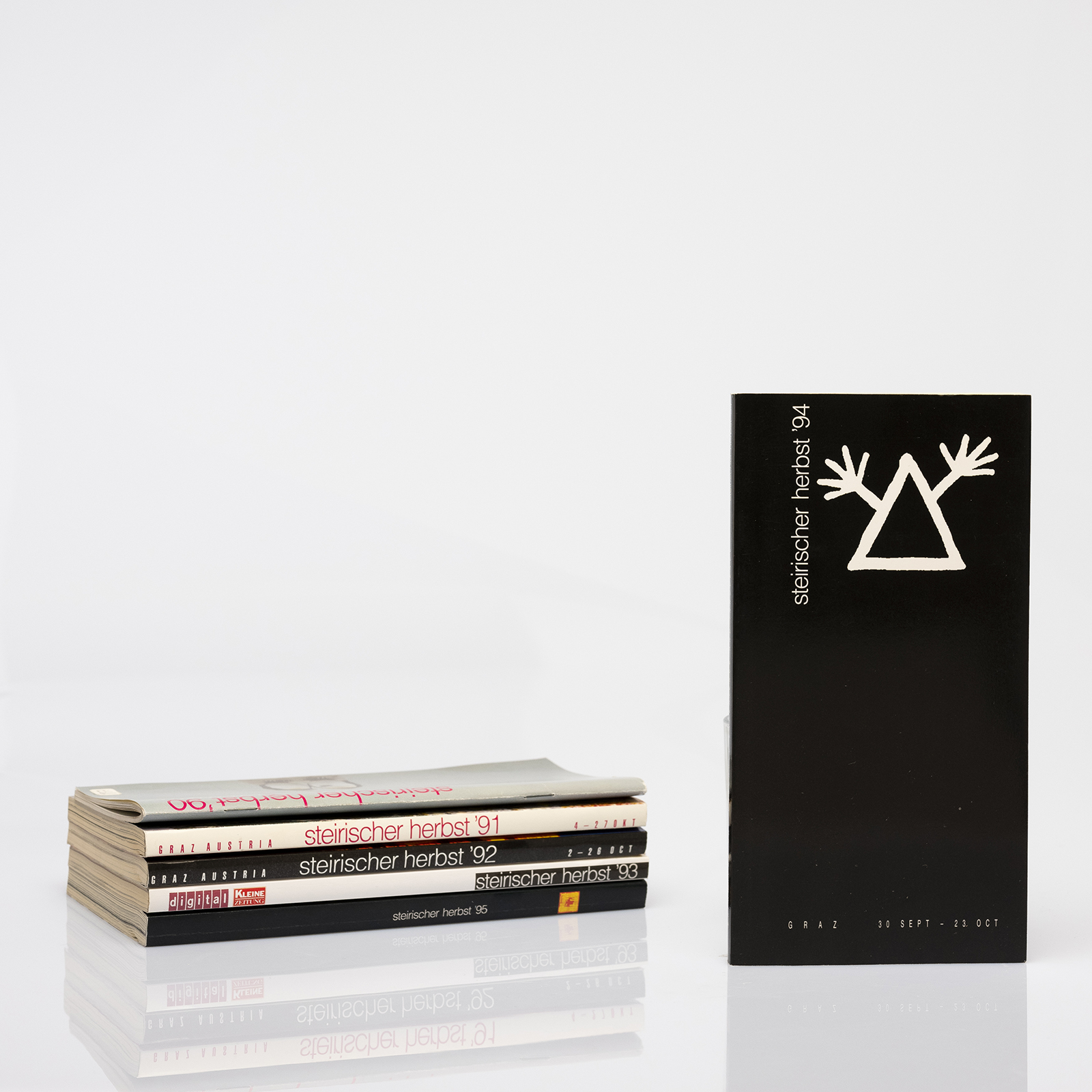
Program booklet of steirischer herbst 1994: steirischer herbst Veranstaltungsges.m.b.H., steirischer herbst ’94 (Graz: steirischer herbst Veranstaltungsges.m.b.H., 1994)
→ Available here

Film Department of Forum Stadtpark, Tempo 60. Hommage à Georges Franju. Stoffwechsel (Graz: 1994)

Paolo Bianchi and Martin Janda, 100 Umkleidekabinen. Ein ambulantes Kunstprojekt (Graz.: steirischer herbst, 1994)
Retrospective
Retrospective